
The Most Interactive Small Animals for Pets That Are Easy to Train
In 2026, the concept of a “caged pet” has become largely obsolete, replaced by a focus on “interactive partners.” For many modern owners, the goal is to find a species that offers the cognitive engagement of a dog within a manageable, small-animal footprint. “Ease of training” in these species is rooted in their natural social structures and high food motivation. We are seeing a significant shift away from sedentary pets toward active, “work-oriented” small animals that thrive on mental stimulation.
The “Big Three” of Trainability
When selecting a small animal for its interactive potential, three species stand out as the gold standards for cognitive engagement.
1. Fancy Rats: The “Pocket Dogs”
Fancy rats are widely considered the most interactive small animals available. They possess a high Emotional Quotient (EQ), allowing them to form deep, empathy-based bonds with their owners.
- Capabilities: They can learn complex tasks such as fetching, jumping

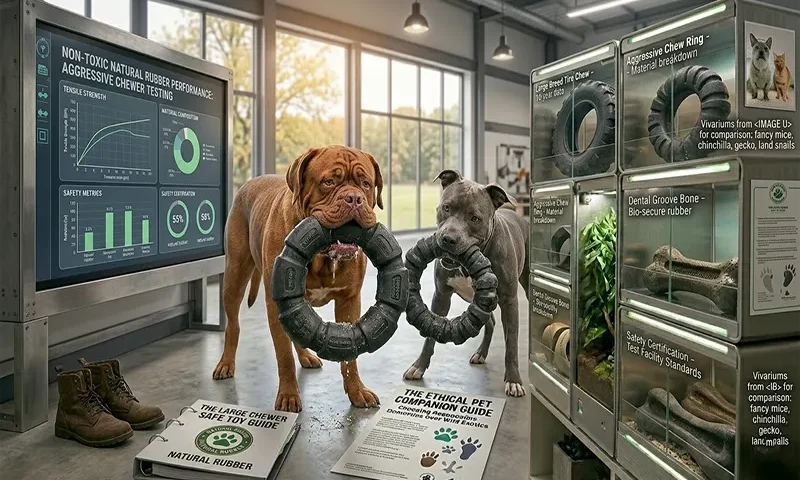
Non-Toxic Natural Rubber Toys for Large Breed Aggressive Chewers
For owners of Mastiffs, Cane Corsos, or American Pit Bull Terriers, the search for a durable toy is often a battle against mechanical destruction. However, the true “Aggressive Chewer” profile involves more than just jaw strength; it involves a “Chemical Mouth” reality—the fact that these dogs spend hours with these objects in their mouths, allowing for significant mucosal absorption of any leachable compounds. In 2026, finding a toy that is both structurally sound and chemically pure is non-negotiable for long-term health.
Material Science: Why Natural Rubber?
Natural rubber, derived from the sap of the Hevea brasiliensis tree, remains the gold standard for heavy-duty canine play due to its unique molecular structure.
The Polymer Advantage
Unlike synthetic thermoplastic elastomers (TPE) or nylon, natural rubber is a high-molecular-weight polymer that exhibits exceptional “rebound resilience.” Under the pressure of large carnassial teeth, the rubber deforms and then instantly snaps back to its original … Read More >>>

How to Find Ethical Pet Adoption Centers for Suburban Homes
In 2026, the shift toward suburban living has changed the “adoption profile” for many families. Suburban environments offer unique benefits like fenced yards and quiet streets, but they also present specific challenges such as close-proximity neighbors, local leash laws, and the frequent presence of delivery drivers or lawn maintenance crews. Finding an ethical adoption center—one that prioritizes the long-term biological and behavioral success of the animal over “rehoming volume”—is the most critical step in ensuring a pet thrives in this specific setting.
The “Green Flags” of Ethical Centers
Identifying an ethical organization requires looking past the photos of cute animals and evaluating their mechanical operations.
- Behavioral Transparency: An ethical center will be candid about a pet’s history, including reactivity to sounds or strangers, which is vital for suburban peace.
- The Vetting Process: Rigorous applications that include veterinary references and home checks are a “green flag,” signaling that the center is

Ethical Alternative Animals for Pets to Own Instead of Wild Exotics
The allure of the unconventional—a primate’s dexterous hands, the sleek coat of a wild felid, or the vibrant plumage of a tropical macaw—has long driven the “Exotic Crisis.” However, in 2026, the ethical landscape of pet ownership has shifted toward a more critical evaluation of the “source-to-home” pipeline. True animal lovers are increasingly recognizing the biological mismatch inherent in keeping wild animals, which often suffer in captivity or contribute to the depletion of wild populations through illegal trafficking.
The modern solution is the “Ethical Surrogate”: domesticated animals that share the fascinating traits of exotics but are genetically and behaviorally suited for a domestic life.
The “Exotic vs. Ethical” Comparison Profiles
For those drawn to specific exotic traits, there are ethical, domesticated alternatives that provide similar enrichment without the welfare compromises.
1. Instead of a Monkey: The Fancy Rat
Many seek primates for their high intelligence and social bonding. However, … Read More >>>

Durable Tug-of-War Toys for Large, Strong Dogs
For the owner of a “power chewer,” the search for a reliable toy is often a cycle of hope and immediate destruction. Large, strong dogs—such as German Shepherds, Rottweilers, and Pit Bull Terriers—possess a bite force that can easily exceed 300 PSI. When this force is combined with a high-velocity “shake” during a game of tug-of-war, standard toys fail mechanically, often becoming dangerous choking hazards.
In 2026, canine gear engineering has shifted its focus from “unbreakable” materials to “mechanical safety,” prioritizing toys that protect the dog’s dental enamel and the owner’s joints while withstanding hundreds of pounds of pull force.
Material Science of Durability
The durability of a tug toy is determined by its ability to absorb energy without structural failure.
- Multi-Layered Ballistic Nylon: Modern high-durability toys utilize reinforced stitching and layered fire hose materials to prevent fraying and punctures.
- Solid-Core Natural Rubber: Unlike hollow toys, solid-core rubber provides the